Pergola vs Retractable Louvre Roof: Which System Fits the Project?.
A practical buyer and specifier guide comparing fixed bioclimatic pergolas with retractable louvre roofs across comfort, cost, wind exposure, maintenance and use case.
A bioclimatic pergola and a retractable louvre roof solve the same broad problem: creating a terrace roof that can manage sun, rain and ventilation. The difference is how much sky you want back when the weather is good.
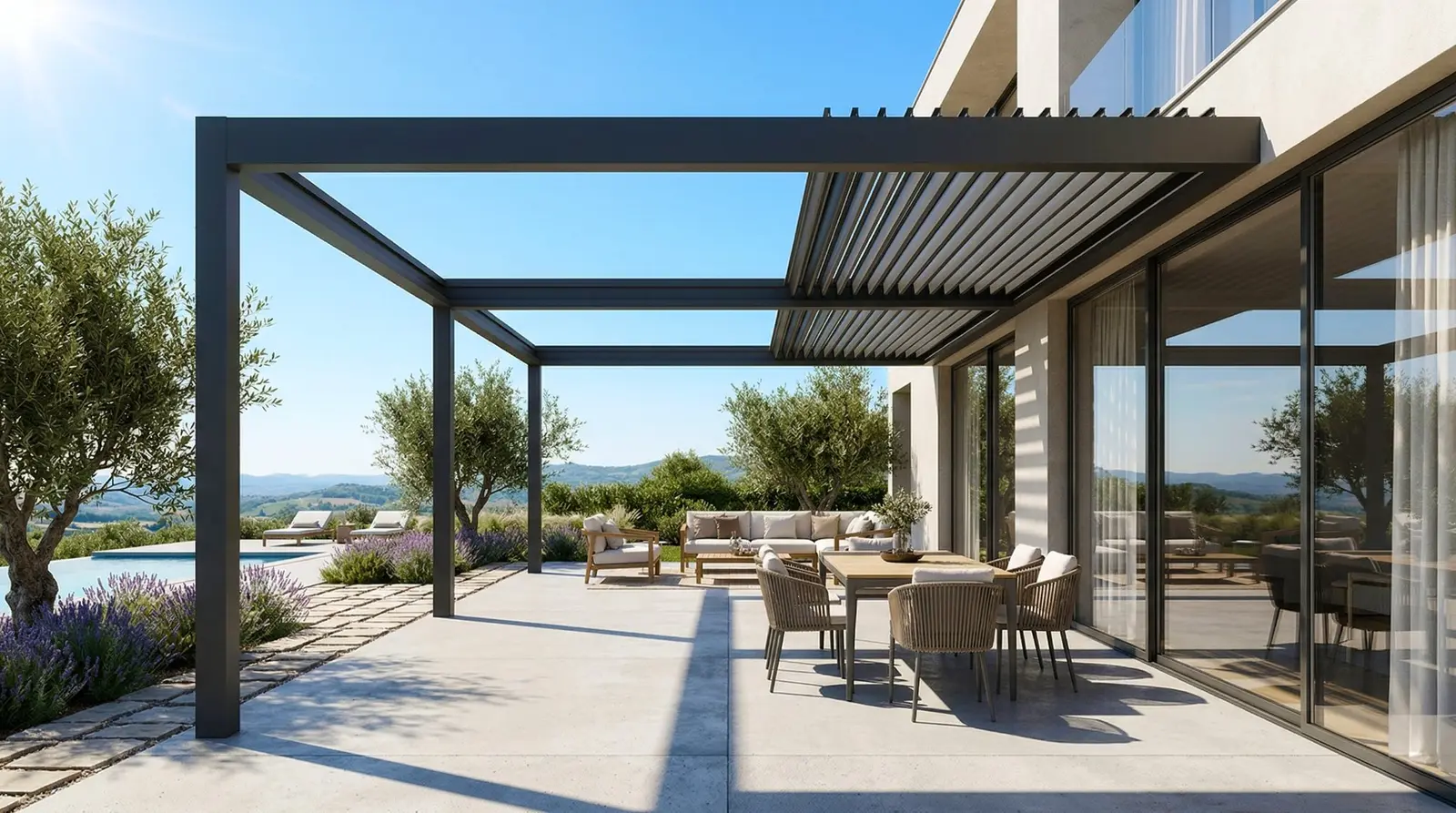
LuxaShade separates the two families clearly. Luxa Sereno 700 and Luxa Sereno 500M are bioclimatic pergolas with rotating aluminium louvres. Luxa Aperio 800 is a retractable louvre roof: the blades rotate, then slide open to one side.
The short answer
Choose a bioclimatic pergola when the project needs the best balance of price, rigidity, simple service and year-round shading. Choose a retractable louvre roof when the client explicitly wants open-sky mode and is willing to pay for the extra mechanism.
For most residential terraces and hospitality extensions, a rotating-louvre pergola is the default specification. For premium villas, rooftop lounges and high-value outdoor dining areas where the roof must disappear visually, a retractable system earns its place.
How the systems work
A bioclimatic pergola uses aluminium louvres that rotate from closed rain protection to an open ventilation angle. The roof always remains physically present, but the blades control daylight, heat gain and airflow.
A retractable louvre roof adds a second movement. The blades rotate and then stack to one side, opening the roof plane. This gives the terrace a full open-sky feeling in good weather and a sealed roof when rain starts.
Cost and specification
The retractable mechanism adds cost, weight and commissioning time. It also needs more careful electrical planning because the system carries both rotation and retraction movements.
Typical specification logic:
- Luxa Sereno 500M: manual pergola for lower-cost residential or secondary spaces. - Luxa Sereno 700: motorised bioclimatic pergola for most residential and hospitality projects. - Luxa Aperio 800: premium retractable louvre roof for projects where open-sky mode is a primary design requirement.
If the client says "we need adjustable shade and rain protection", specify the pergola first. If they say "we want the roof completely open when possible", specify the retractable roof.
Wind, snow and exposed sites
Both systems must be checked against EN 1991 wind and snow loads. The site location matters more than the product name. Coastal wind, alpine snow and rooftop turbulence can change the frame, post and reinforcement requirements.
Use the wind and snow specifier calculator early in the conversation. It gives the commercial team and architect a first-pass load envelope before a final structural calculation.
For a deeper explanation, read the pergola wind-load guide and the Eurocode 1 national annex guide.
Comfort and daily use
A rotating-louvre pergola is simple to live with. The owner adjusts the louvre angle during the day, closes the roof for rain and opens it again for ventilation. With sensors, this can be automated.
A retractable louvre roof changes the terrace mood more dramatically. In open-sky mode, the roof plane disappears and the space feels closer to an uncovered patio. That is the emotional reason clients choose it.
The trade-off is service complexity. More movement means more components to inspect: rails, drive system, blade stack alignment and weather seals.
Maintenance
Both systems use powder-coated aluminium frames and require periodic cleaning, drainage checks and motor inspection. The retractable roof adds track cleanliness and drive alignment to the maintenance list.
For exterior aluminium, coating quality matters. QUALICOAT Class 2 and correct pre-treatment protect colour retention and corrosion resistance. Coastal projects may need Seaside or marine-grade preparation. See the Qualicoat Class 2 guide and coastal coating guide.
Which projects fit each system?
| Project type | Better fit | Why | |---|---|---| | Standard residential terrace | Bioclimatic pergola | Best comfort-to-cost ratio | | Restaurant terrace | Bioclimatic pergola | Robust, predictable, easier to service | | Premium villa terrace | Retractable louvre roof | Open-sky experience matters | | Rooftop lounge | Depends on wind zone | Check wind loads before product choice | | Coastal hotel | Bioclimatic pergola or reinforced retractable | Coating and wind exposure dominate | | Small garden seating area | Manual pergola | Lower cost, no electrical work |
Product recommendation
Start with the pergola category when the brief is comfort, shade, rain protection and long service life. Move to the retractable louvre roof category when the brief includes a strong open-sky requirement.
For mixed projects, compare the systems side by side in the pergola comparison tool and validate the site exposure with the specifier calculator.
Conclusion
A retractable louvre roof is not a "better pergola"; it is a different answer to a different brief. The best SEO and sales terminology should keep this distinction visible: bioclimatic pergola for adaptive shade and weather protection, retractable louvre roof for open-sky high-spec terraces.
Project checks before specification
For a reliable LuxaShade proposal, match the article topic with the real site conditions before selecting a product family.
- Confirm span, fixing surface, drainage route and wind exposure for the installation area.
- Compare pergola, zip screen, veranda, carport and railing options against the same opening dimensions.
- Share photos, rough measurements and preferred colour so the dealer can route the request to the right system.
Use the product pages for system details, then contact LuxaShade for a project-specific review.
Explore our product range or get in touch.