Bioclimatic Pergola: The Complete Guide for Homeowners & Architects.
A practical guide to bioclimatic pergolas — how they work, key benefits, sizing, materials and what to look for when choosing a system.
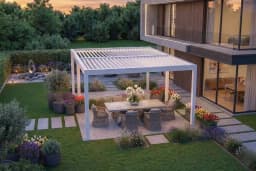
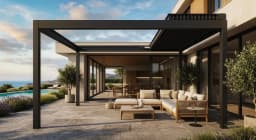
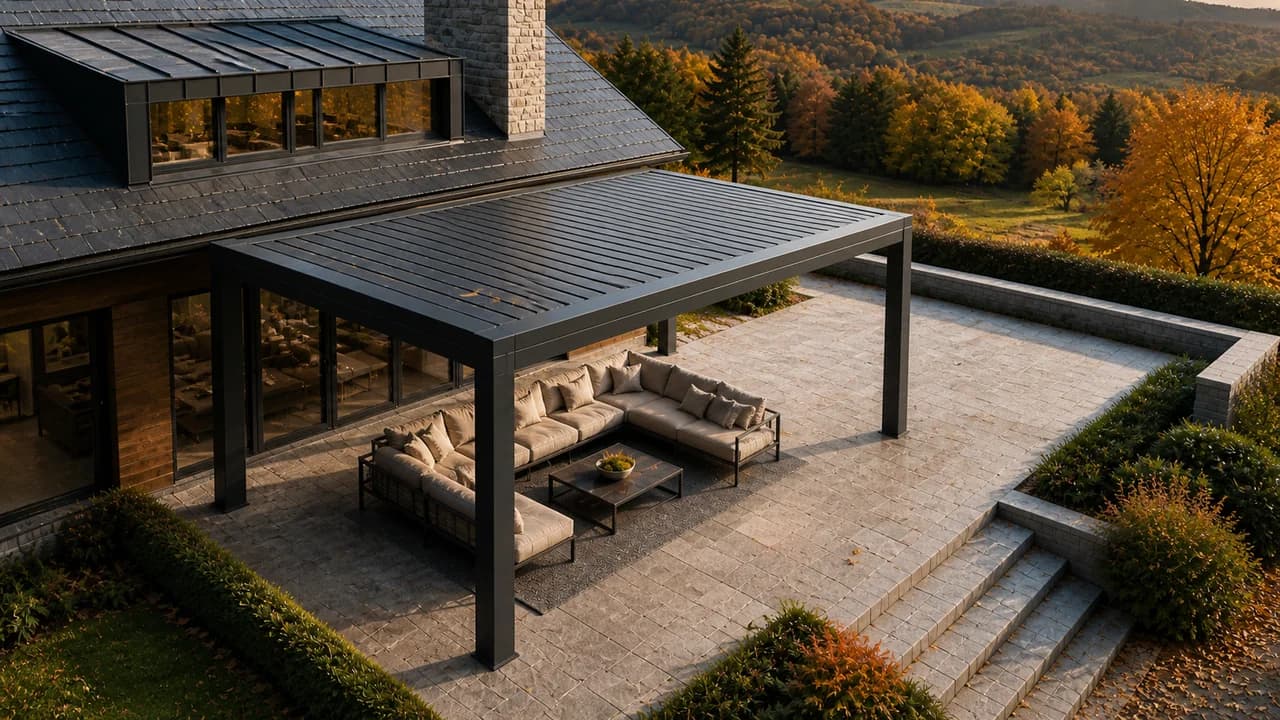
A bioclimatic pergola is an outdoor structure with adjustable aluminium louvre blades that rotate up to 115°, giving you precise control over sunlight, ventilation, and rain protection — all from a single system.
How Does a Bioclimatic Pergola Work?
The core principle is simple: motorised aluminium louvres pivot between fully open and fully closed positions. When open, natural light and air flow through freely. When closed, the blades interlock to form a watertight roof with integrated drainage channels that route rainwater silently through the structural columns.
This means you can use your terrace in virtually any weather — adjusting the louvre angle throughout the day to match the sun's position, creating shade without blocking daylight entirely.
Key Benefits
Year-round outdoor living. Unlike fixed roofs or fabric awnings, a bioclimatic pergola adapts to the season. Open in summer for ventilation, closed in rain, angled for winter sun.
Energy savings. By controlling solar gain on adjacent glass facades, a well-positioned pergola can reduce indoor cooling loads by 30–40% in summer.
Durability. All-aluminium construction with powder-coated finishes (QUALICOAT Class 2 powder coat or equivalent) resists UV, salt spray, and temperature extremes. No wood rot, no fabric degradation.
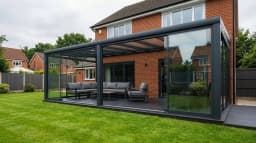
Architectural integration. Modern pergola systems offer clean lines with concealed fixings, LED lighting integration, and optional side elements (glass walls, zip screens, fabric blinds).
What to Look For When Choosing
Louvre opening angle. The wider the angle, the more light and air. 115° is the current benchmark — anything less limits ventilation.
Drainage system. Look for concealed channels that route water through the columns, not drip edges. This keeps the terrace dry and the system silent.
Structural certification. In Europe, ask for EN 1991 wind and snow load calculations. A properly engineered pergola should handle local climate loads without oversized columns.
Coating quality. Specify QUALICOAT Class 2 or QUALICOAT Class 2 powder coat for 15+ year colour retention. Cheap powder coats fade within 3–5 years.
Motor quality. Silent motors with integrated rain and wind sensors are standard on premium systems. Manual override should be available for power outages.
Standard Sizes
Most manufacturers offer modules from 3×3m to 6×4m. For larger spans, modular systems connect multiple units seamlessly. Column-free spans up to 6 metres are achievable with reinforced beam profiles.
Motorised vs. Manual
Motorised systems (like the Luxa Sereno 700) offer remote control convenience and sensor automation. Manual systems (like the Luxa Sereno 500M) use a gear crank — no electricity needed, lower cost, same structural performance.
Cost Factors
The main cost drivers are: span size, number of modules, coating finish, side elements (glass, screens), electrical/automation features, and installation complexity. A single freestanding pergola typically ranges from €8,000 to €25,000 depending on specification.
Freestanding vs wall-mounted: how to decide
Freestanding pergolas (4 columns) work everywhere — no wall to attach to, full 4-side air-flow, easy to relocate. The trade-off: larger footprint, all 4 columns visible. Wall-mounted variants (2 columns + a wall ledger) cut the column count in half and integrate visually with the building, but require a load-bearing wall capable of carrying ~30–40 kg/m² of dead load + the tributary wind load. For brick/CMU walls thicker than 200 mm this is rarely an issue; for thin timber-frame or aerated-concrete walls, an engineered ledger plate is mandatory. Most hospitality projects (restaurant terraces, hotel pool decks) use wall-mounted to maximise usable seat area; most residential projects use freestanding for installation simplicity.
Wind and snow load: what EN 1991 actually means for your specification
Pergolas are *outdoor structures*, not garden furniture — every European specification must reference EN 1991-1-3 (snow) and EN 1991-1-4 (wind). The site's wind zone (vb,0 in m/s) and snow zone (sk in kN/m²) drive the column sizing, beam profile and louvre spacing. A pergola sized for North Sea coast (DE Wind Zone 4, qb 0.56 kN/m²) needs different reinforcement than the same pergola in the Apennine foothills (IT Zone 1, qb 0.39 kN/m²). The destination country's national annex matters — see the Eurocode 1 NA differences article for the country-by-country comparison. For a first-cut load envelope on your candidate site, run the wind & snow specifier calculator.
For hospitality projects, an additional code stack applies — EN 13501 fire class (A1 frame, A2-classified panels for indoor-adjacent use), EN 1090 EXC2 execution class on the load-bearing aluminium, and per-country building permit (DE Bauantrag, FR DP/PC, IT SCIA, ES licencia) for any structure above the local exempt-size threshold.
25-year total cost of ownership
A bioclimatic pergola is a 25-year asset, not a 5-year purchase. The realistic TCO breakdown (per m² of canopy area, EU average):
- Year 0 (initial): €450–650/m² depending on motorisation, side elements, coating class. - Years 1–5: ~€10/m² annual cleaning, no other cost. - Years 5–10: ~€20/m² motor service interval (electric models only), grease re-application on louvre pivots. - Years 10–15: optional re-coating if the project is in a coastal salt-spray environment without Seaside upgrade — €60–80/m². - Years 15–25: motor replacement if needed (~€400–600 for the motor unit, retrofit on the existing structure).
Total 25-year TCO: ~€600–900/m² for a freestanding motorised system. Compare to a fabric awning (€300/m² initial + replace every 8–10 years = ~€800/m² over 25 years) — the bioclimatic pergola wins on lifecycle cost despite the higher day-one investment, because the structural aluminium doesn't degrade.
Coastal, hospitality, and high-altitude variations
Three contexts where the standard specification needs an upgrade:
- Coastal hospitality (≤ 5 km from open coast): specify Qualicoat Seaside pre-treatment, not just Class 2. The chloride deposition rate at the coast pushes Class 2 past its tested service life. See the Qualicoat Seaside vs Qualimarine article. For ≤ 1 km of breaking surf, upgrade to Qualimarine. - Hospitality vertical (restaurant, hotel, public-frequented terrace): EN 13501 fire class A1 / A2 framework, plus per-country fire-permit documentation. See the EN 13501 article. - Alpine / high-altitude (≥ 600 m DE/AT, ≥ 1000 m CH): the snow zone trigger altitudes apply — site-specific structural calc replaces the mapped-zone shortcut. Standard product pricing + lead time only applies to mapped-zone sites; alpine projects are quoted per site. The reinforced beam profile and column spacing are determined by the site-specific qk (characteristic snow load).
For projects that overlap multiple of these, the engineering team prepares a per-project specification stack — request via the contact form with the project location, intended use, and altitude.
Conclusion
A bioclimatic pergola is one of the most versatile outdoor additions you can make — bridging the gap between open terrace and enclosed room. When specified correctly, it adds usable outdoor space, reduces energy costs, and enhances architectural value.
Project checks before specification
For a reliable LuxaShade proposal, match the article topic with the real site conditions before selecting a product family.
- Confirm span, fixing surface, drainage route and wind exposure for the installation area.
- Compare pergola, zip screen, veranda, carport and railing options against the same opening dimensions.
- Share photos, rough measurements and preferred colour so the dealer can route the request to the right system.
Use the product pages for system details, then contact LuxaShade for a project-specific review.
Explore our product range or get in touch.