Energy Performance of External Shading: How to Reduce Cooling Loads project-dependent.
Understand how external shading reduces cooling costs, Fc values (solar factor), comparison of shading types, green-building documentation credits, and ROI calculation.
External shading systems are one of the most effective passive energy strategies available to architects and building managers. This guide explains the physics, standards, and financial returns.
How External Shading Reduces Cooling Loads
The Solar Radiation Path: Direct sunlight passes through window glass, warming interior surfaces. A typical south-facing facade in northern Europe receives 500–700 W/m² of solar radiation on summer days.
Without shading: This energy is absorbed by interior surfaces (walls, furniture, people), raising indoor air temperature. Air conditioning must counteract this gain.
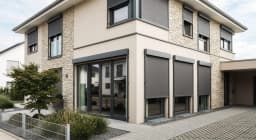
With external shading: The solar radiation is intercepted BEFORE reaching the glass, reducing the cooling load by 60–85% depending on shading type.
Why external? External shading is more effective than internal (blinds inside) because it blocks heat before it enters the building, whereas internal shading absorbs heat between glass and room.
Key Performance Metrics
Fc Value (Solar Factor): - Range: 0.0 (complete blockage) to 1.0 (no blockage) - Fc 0.20–0.30: Optimal for southern facades in warm climates - Fc 0.30–0.50: Balanced for daylighting + solar control - Fc 0.50+: Minimal control, primarily for privacy
U-Value (Thermal Transmittance): - Shading system alone doesn't improve U-value - But combined with low-E glass (U 0.8–1.2 W/m²K), total facade performance improves - External shading reduces solar load; low-E glass prevents heat loss in winter
g-Value (Shading Coefficient): - Legacy metric, largely replaced by Fc - Still used in some building codes (France, Austria) - Approximately: g = 0.87 × Fc (for unshaded window)
Shading Type Comparison
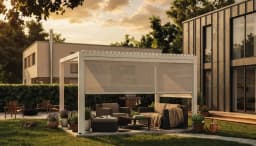
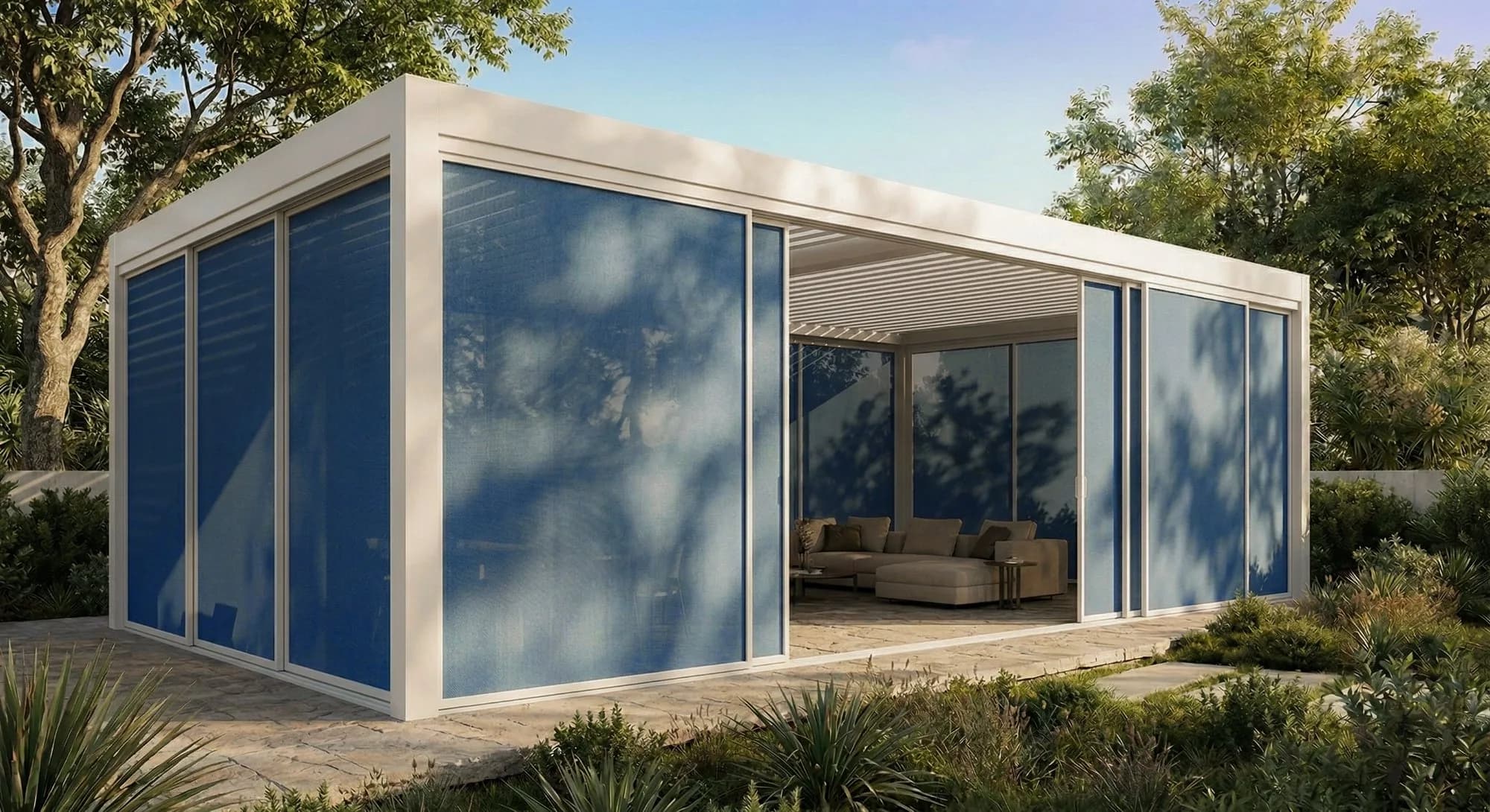
Bioclimatic Pergolas ([Luxa Sereno 700](/en/products/pergolas/luxa-700)): - Fc: 0.15–0.25 (closed position) - Cooling load reduction: 35–40% - Lifespan: 25–30 years - Cost: €15,000–€30,000 (4×4m) - Annual energy savings: €800–€1,200 (4m² south-facing)
Zip Screens ([Luxa Tela 100](/en/products/zip-screens/luxa-100)): - Fc: 0.25–0.40 (sheer mesh) - Cooling load reduction: 25–30% - Lifespan: 12–15 years - Cost: €3,000–€8,000 (window-sized) - Annual energy savings: €150–€300 (per window)
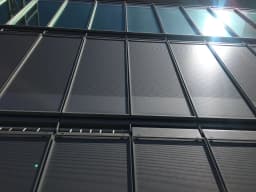
Brise Soleil (Fixed or Sliding): - Fc: 0.10–0.50 (depending on density) - Cooling load reduction: 30–50% - Lifespan: 20–25 years - Cost: €400–€2,000 per m² (facade area) - Annual energy savings: Varies by building size
Fabric Awnings: - Fc: 0.35–0.55 - Cooling load reduction: 15–25% - Lifespan: 10–12 years - Cost: €200–€600 per m² - Annual energy savings: €50–€100 (per m²)
green-building documentation & green-building documentation Credits
green-building documentation v4.1 — EAc2 (Optimized Energy Performance): Buildings using external shading to achieve 15% energy savings above baseline earn 5 points. 25% reduction = 10 points. Bioclimatic pergolas and fixed brise soleil typically enable 15–25% reductions.
green-building documentation (UK Standard): - Ene1 (Reduction of CO2 emissions): 15 points for shading systems achieving Fc ≤0.30 - Ene2 (Sub-metering of significant energy uses): 4 points for monitoring thermal performance
Certification Paths: - Gold: 15% energy reduction (shading contributes 5–8%) - Platinum: 25%+ energy reduction (shading contributes 8–12%)
Financial ROI Calculation
Example: 100 m² South-Facing Office Building Facade
Scenario 1: Bioclimatic Pergola (Luxa Sereno 700) - Installation cost: €25,000 (€250/m²) - Annual cooling energy: 150,000 kWh (baseline) - With shading: 105,000 kWh (30% reduction) - Annual savings: 45,000 kWh × €0.15/kWh = €6,750 - Payback period: 3.7 years - 20-year NPV (at 3% discount): €89,000
Scenario 2: Zip Screens + Low-E Glass - Zip screens: €8,000 (€80/m²) - Low-E glass replacement: €12,000 - Total: €20,000 - Annual cooling reduction: 25% (45,000 kWh) - Annual savings: €6,750 - Payback: 2.96 years - 20-year NPV: €95,000
Scenario 3: Fixed Brise Soleil - Material & installation: €30,000 (€300/m²) - Annual cooling reduction: 35% (52,500 kWh) - Annual savings: €7,875 - Payback: 3.8 years - 20-year NPV: €102,000
Design Integration
Orientation-Based Strategy: - South-facing: Fixed louvres at 40–50° angle (blocks summer sun, admits winter sun) - East/West: Vertical fins + horizontal louvres (challenges: low morning/evening angles) - North-facing: Usually unnecessary except for reflection control
Daylighting Balance: External shading reduces glare but can reduce useful daylight by 15–25%. Design solution: - Use semi-transparent shading (Fc 0.30–0.40) instead of full blockage - Combine with high windows to bring light deep into space - Use light shelves or reflective surfaces to redirect light
Aesthetics: - Fixed systems: Architectural statement, clean geometry - Motorised: Modern, responsive to occupant needs - Material choice: Aluminium (low routine care), wood (aesthetic), stainless steel (coastal durability)
Conclusion
External shading is one of the most cost-effective energy upgrades available. A well-designed system combining bioclimatic pergola or brise soleil with low-E glass can reduce cooling loads by 30–40%, earning green-building documentation credits, and paying for itself in 3–5 years. Over a 20-year building lifecycle, energy savings exceed €80,000–€100,000 for a typical 100 m² facade.
Project checks before specification
For a reliable LuxaShade proposal, match the article topic with the real site conditions before selecting a product family.
- Confirm span, fixing surface, drainage route and wind exposure for the installation area.
- Compare pergola, zip screen, veranda, carport and railing options against the same opening dimensions.
- Share photos, rough measurements and preferred colour so the dealer can route the request to the right system.
Use the product pages for system details, then contact LuxaShade for a project-specific review.
Explore our product range or get in touch.