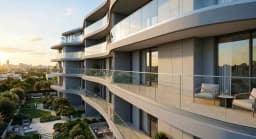
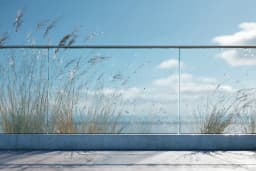
Glass railing vs stainless cable railing — code, cost, and TCO compared.
A specifier-grade comparison of frameless glass railings (VSG/EN 14179/DIN 18008-4) and tensioned stainless cable balustrades. Code certainty, wind/snow behaviour, maintenance regime and 10-year TCO.
Two systems compete for the same brief — terrace, balcony or roof-level fall protection where the architect wants minimum visual obstruction. Frameless glass (toughened laminated, EN 14179 ESG-H + EN 14449 VSG, DIN 18008-4 categorised) and tensioned stainless cable (316L stainless wire, terminal-fitted balusters). They look similar in renderings; they perform very differently in service. Here's the side-by-side, focused on the four decision factors specifiers actually use.
1. Code certainty
Frameless glass sits in a fully mapped regulatory framework. EN 14179 + EN 14449 define the product. DIN 18008-4 (in DACH), BS EN 1991-1-1 NA (in UK), NF DTU 39 (in FR) define the *application* — exactly which glass-build is permitted in what configuration, edge support, and load class. A specifier writes "DIN 18008-4 Kategorie A, 10.10.4 mm VSG aus 2× ESG-H" and every component is determined.
Cable balustrades are not formally categorised in DIN 18008 (it's a glass standard) and only loosely covered by EN 13374 (temporary railings during construction). For permanent fall-protection cable balustrades, German Bauamten typically require a project-specific *abZ* (allgemeine bauaufsichtliche Zulassung) demonstrating cable tension, end-fitting pull-out values, and post-spacing per the live load. Each project re-litigates the spec — adds 3–4 weeks and ~€1500–3000 in engineering fees.
For a tender that needs to ship without permit-route ambiguity, glass wins on day one.
2. Wind + snow behaviour
Glass is a rigid panel. Wind pressure deflects it elastically (~5–8 mm at qb 0.5 kN/m² for a 1.1 m × 1.5 m panel) and recovers fully. Snow accumulation on a glass-edge balustrade is irrelevant — vertical surface, no shelf. The DIN 18008-4 calc covers the wind envelope per EN 1991-1-4 NA and that's the design driver.
Cable is a tensioned wire. Wind pressure acts on the *people* leaning on it, not on the wire — but the wire's ability to resist horizontal load depends entirely on its pre-tension (typically 1500–2500 N per cable). Pre-tension drifts: stainless 316L stretches by ~0.1–0.3 % over 5 years, more in salt-spray environments. A loose cable balustrade is a fall-protection failure. Annual tension audit + retensioning is required for code-compliant operation. Snow doesn't accumulate on cable, but ice can — adding ~10–15 % to the apparent diameter and changing the visual + drag profile.
3. Maintenance regime + TCO
Glass: - Cleaning: 2–4× per year, soap + water, ~5 minutes per panel. - Lifecycle: 25+ year service life. ESG-H means spontaneous nickel-sulfide breakage is screened out at the factory. - Replacement: the laminated PVB interlayer holds shards together if a panel does break — the failed panel is replaced as a whole unit, no scaffold reinstatement. - 10-year TCO (per metre of railing): ~€350–450 (initial €280–380 + cleaning ~€10/year × 10 + 0–1 panel replacement reserve).
Cable: - Annual tension audit: ~€80–120 per audit (specialist + test gauge). - Retensioning every 12–24 months: ~€20–40 per cable, ~€150–250 per audit visit. - End-fitting inspection: every 5 years, replace fittings showing pitting (especially in coastal projects). - 10-year TCO (per metre): ~€280–380 (initial €120–180 + €150–200 in audit/retensioning + replacement reserve €30–50).
Cable looks cheaper on day one (~€60–200 less per metre), but the audit + retensioning regime narrows the gap to ~€20–80/m advantage by year 10. In hospitality contexts (where audit downtime + tradesman visibility on-site is a UX cost), the gap closes further.
4. Aesthetic + visual obstruction
This is where cable wins on perception:
- Glass has a visible reflection, ~8–10 % light blocking in clear configurations, more in laminated / heat-soaked. The glass edge is visible at angle. - Cable is ~3 mm wires at 100–125 mm spacing — visually nearly invisible against most backgrounds.
But two specifier counter-considerations:
- Children (under 4 yrs) can in some cases use cables as a foothold to climb over a balustrade — non-trivial concern in residential / hotel + family-resort contexts. Cable balustrades are not recommended where children frequent the space without supervision. - Glass bird-strike: in nature-adjacent installations, glass can cause bird collisions. Decals or fritted glass mitigates this; cable doesn't have the issue.
When to pick which
| Use case | Glass | Cable | |---|---|---| | DACH B2B specifier (DIN 18008 needed) | ✅ | abZ project-by-project | | Coastal hospitality (≤ 5 km from coast) | ✅ + Seaside coating | ⚠ + corrosion audit | | Family residential / hotel | ✅ | ⚠ child-climb risk | | Listed building / heritage retrofit | ⚠ visual change | ✅ minimal visual impact | | Net-zero / lifecycle certification | ✅ closed-loop recycled glass | ⚠ stainless lifecycle higher | | Bird-strike-sensitive (forest, riverbank) | ⚠ requires fritting | ✅ | | Lowest day-one cost | — | ✅ | | Lowest 10-year TCO | ✅ marginally | — |
Connecting back to our products + standards hub
The PONARC group glass railing range — VisioMod Cristallo frameless toughened, channel-mounted or post-mounted variants — is fully DIN 18008-4 categorised and EN 14179 / EN 14449 certified. Each spec sheet lists the DIN 18008 category mapping (A, B or C) and the glass-build combination. Our engineering team supports the project-specific calc against DIN EN 1991-1-4 NA for any country.
For the regulatory deep-dive, see the DIN 18008 article, the EN 12150 vs EN 14179 article, and the glass section of the standards hub. For wind-load context, the wind & snow specifier calculator.
---
*Comparing glass + cable for a specific project? Contact our engineering team — we provide a side-by-side compliance + TCO sheet within two working days.*
Project checks before specification
For a reliable LuxaShade proposal, match the article topic with the real site conditions before selecting a product family.
- Confirm span, fixing surface, drainage route and wind exposure for the installation area.
- Compare pergola, zip screen, veranda, carport and railing options against the same opening dimensions.
- Share photos, rough measurements and preferred colour so the dealer can route the request to the right system.
Use the product pages for system details, then contact LuxaShade for a project-specific review.
Explore our product range or get in touch.